


Extraordinary Attorney Woo is one of my all-time favorite Netflix dramas.
I'm also really looking forward to the Japanese remake, Attorney Minamida Minami Is a Genius, starring Mana Ashida, which begins airing on October 19, 2026!
In the original, Attorney Woo Young-woo, who has autism spectrum disorder, always eats kimbap because she feels reassured that she can see everything inside. These days, you can easily pick up kimbap at convenience stores and supermarkets in Japan.
Kimbap is popular in Japan, but do you know where it came from? It actually has deep ties to Japan.
In this article, I'll explain the origins of kimbap and when and how people eat it in Korea.
I'll also share a few simple tips for making kimbap at home without any mistakes, so please read to the end!
What Is Kimbap?
Kimbap is a Korean dish made of rice and fillings rolled in dried seaweed. "Kim (김)" means seaweed and "bap (밥)" means rice, so the name literally means "seaweed rice."
The rice is usually seasoned with salt and sesame oil, and the fillings often include egg, vegetables, beef, and pickled yellow radish (danmuji). The exact recipe varies from household to household.
In English, you'll see it spelled both "kimbap" and "gimbap." In Korea, it sounds close to "gim-bahp."
Here are two tips for saying it like a native speaker:
- Say the second syllable like the "ah" in "father," not like the "a" in "cap." So it's "bahp," not "bap" or "bop."
- Don't release the "p" at the end. Close your lips and stop, without a puff of air and without adding an "uh" sound.
Get these two right and it will sound much closer to the way Koreans say it. Give it a try!
Is Kimbap Based on Japanese Futomaki? The Origin Theories
There are several theories about where kimbap came from. Here are the two best-known ones.
| Theory 1 | Theory 2 | |
|---|---|---|
| Origin | Japanese norimaki (futomaki) | Korean "bokssam" (복쌈) |
| Summary | Futomaki was introduced to Korea during the Japanese colonial period and developed into its own Korean dish. | Old Korean cookbooks describe wrapping rice in seaweed or blanched leafy vegetables. |
| Details | Futomaki looks very similar to kimbap. | "Bok" (복) means fortune and "ssam" (쌈) means wrap. It was eaten on the 15th day of the first lunar month, in hopes of a good harvest. |
Personally, I think the first theory is more convincing, because Japanese futomaki looks much more like kimbap.
Kimbap vs. Futomaki: What's the Difference?
Kimbap and futomaki are both dishes made by rolling rice and fillings in dried seaweed.
The easiest difference to spot is the seasoning of the rice: kimbap rice is usually seasoned with sesame oil and salt, while futomaki uses sushi rice seasoned with vinegar.
| Comparison | Kimbap | Japanese Futomaki |
|---|---|---|
| Rice | Often seasoned with sesame oil and salt | Sushi rice seasoned with vinegar |
| Typical fillings | Beef, egg, carrot, spinach, pickled yellow radish (danmuji), etc. | Egg, dried gourd strips (kanpyo), shiitake mushrooms, cucumber, etc. |
| Flavor | Known for the nutty aroma of sesame oil | Known for the tang of vinegared rice |
| Finishing | The outside of the roll is sometimes brushed with sesame oil and sprinkled with sesame seeds | Usually not brushed with sesame oil |
Just as the fillings in Japanese futomaki differ from home to home, the fillings in kimbap vary from household to household.
By the way, I don't season the rice in my kimbap at home, so it has a light flavor. The fillings are already seasoned, and I felt that adding salt to the rice would make it too salty. My husband also doesn't like sesame oil 🥲
When Do Koreans Eat Kimbap?
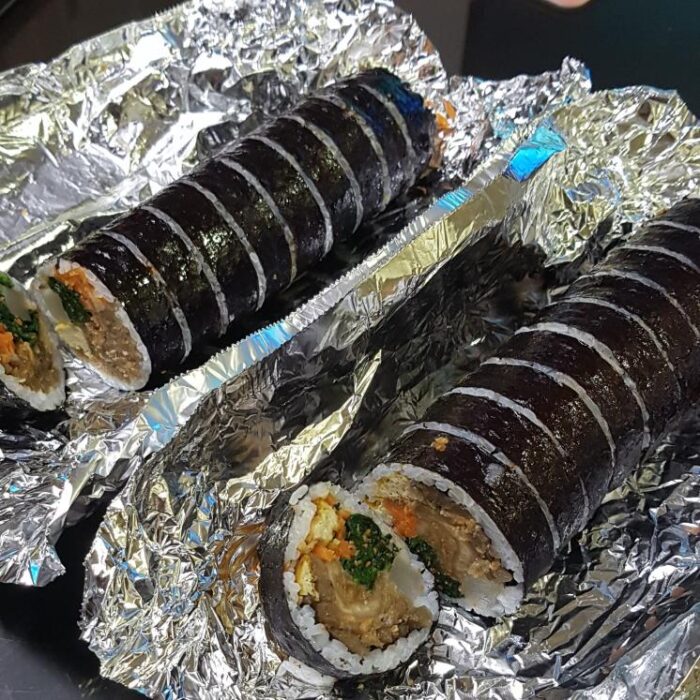
So when do people in Korea actually eat kimbap?
I feel that kimbap's place in everyday life has changed quite a bit since I was a child.
Let me show you how it has changed.
Kimbap: The Classic Field Trip Lunch
In Korea, kimbap has long been a staple of the field trip lunch box.
When I was in elementary school, my mother always made kimbap for field trips, and most of my friends brought it too.
Kimbap takes a lot of work, because you have to prepare each filling one by one. That made it a special food for special days like field trips.
It wasn't special because the ingredients were expensive. It was special because it took so much time that no one could easily make it on a busy morning.
Every home makes it a little differently, so swapping one piece with friends was part of the fun!
Kimbap Today: An Easy Meal, Like a Sandwich
Kimbap is loved as a field trip lunch, but today it is also an everyday food that people choose for a quick lunch on a busy day or a small snack when they get hungry.
It still takes time to prepare the fillings and roll it, but if you make a large batch of ingredients in advance, you can put it together whenever you like.
Because it is made with rice rather than bread, like a sandwich or toast, it keeps you full for a long time! With vegetables, egg, and meat inside, it is also a well-balanced meal in itself.
In Korean dramas, you often see characters biting into kimbap wrapped in aluminum foil.
Kimbap's Popularity Around the World
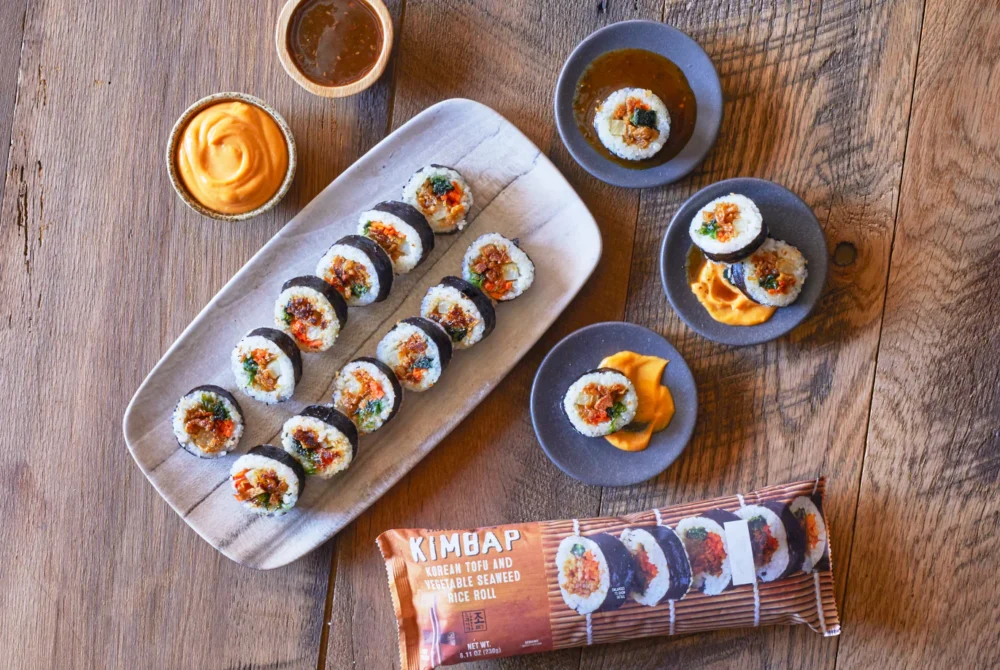
Kimbap is popular in Japan, and it has also become popular in the U.S. and other Western countries.
One of the things that helped spread kimbap's popularity in the U.S. was the frozen kimbap sold at the grocery chain Trader Joe's.
After it launched in August 2023, a video of a Korean American creator trying it with her mother went viral on TikTok. The $3.99 price and the convenience of heating it in the microwave also drew attention, and the product sold out in about two weeks and became a hot topic on social media.
You could say the boom came from interest in Korean culture through K-pop and Korean dramas, combined with word of mouth on social media.
Interest picked up again when a scene of characters eating kimbap appeared in Netflix's worldwide hit KPop Demon Hunters. Videos of people copying the way they ate it, or making kimbap themselves, spread online.
Tips for Making Foolproof Kimbap
There are no hard-and-fast rules for kimbap.
Sometimes I make it as a way to use up the vegetables in my fridge. People add all kinds of things, such as tuna mayo, pork stir-fried in gochujang with perilla leaves, or kimchi.
Here is how kimbap is commonly made. Please use it as a general guide.
Kimbap Ingredients and How to Make It
Here is how to make kimbap, with ingredients for 2 servings.
Key Points for Making Kimbap Without Mistakes
With just a little care, you can make neat kimbap that doesn't tear.
Please keep the following points in mind.
- Cook the Rice a Little Firm
If the rice is soft, it is hard to spread evenly over the seaweed. - Spread the Rice Thinly
If there is too much rice, the roll is hard to close, and the cut slices don't look neat. Spread the rice as thinly as you can. - Drain the Fillings Well
Kimbap spoils easily. Also, if moisture is left in the fillings, it soaks into the rice and spoils the texture. - Let the Roll Rest Before Cutting
Letting the roll rest allows the seaweed to cling firmly to the rice, which makes it easier to cut.
Kimbap's Popularity Around the World
In this article, I introduced the theory that kimbap came from Japanese futomaki, which was brought to Korea and developed in its own way.
I also covered how people in Korea eat kimbap, how popular it has become overseas, and some tips for making it well.
Kimbap is a big hit at my house, too. In fact, we had it for dinner tonight 😊
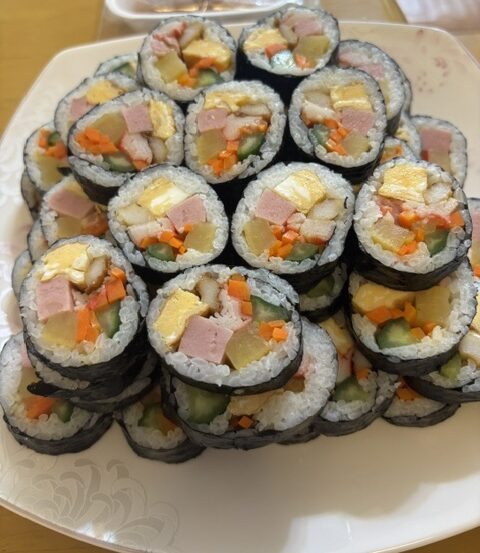
My child loves kimbap so much that they say they would never get tired of eating it every day.
As long as you prepare the ingredients well, it is an easy dish to make, even for someone like me who isn't good at cooking.
Please give it a try!

